Sonictroller
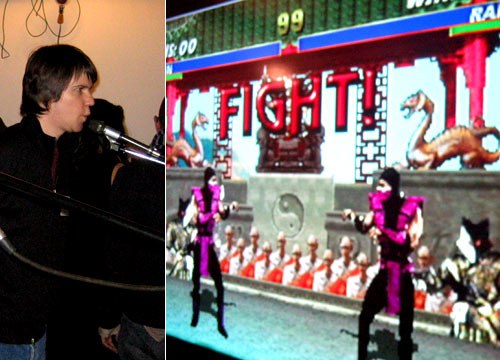
Sonictroller is an interface that allows the user to control video games with acoustic musical instruments.
Sonictroller is an interface that allows the user to control video games with acoustic musical instruments.
Auditory calendar for the visually impaired.
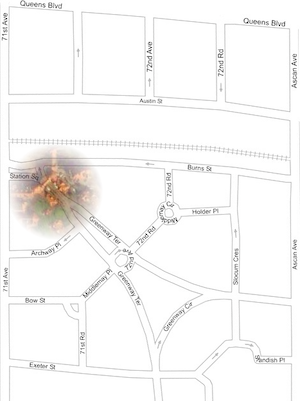
Forest Hills Sound Map is a sound map consisting of field recordings made in 2005 in my former neighborhood, Forest Hills.
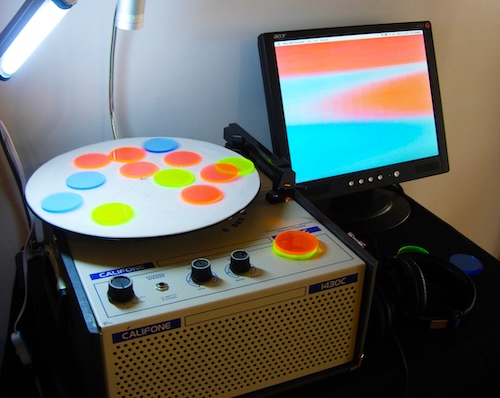
spinCycle is a synesthetic turntable that allows you to arrange and play colors visually and musically.
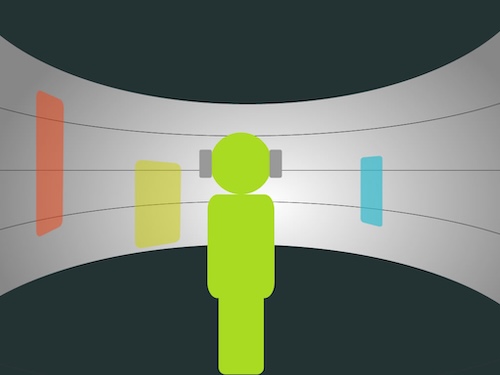
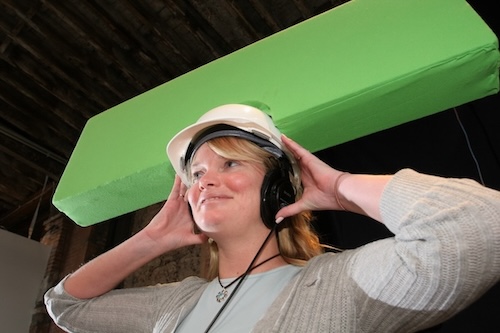
Sonic Body Pong is based on Atari’s classic video game Pong, and takes place in real space, with the players using their bodies as paddles. The ball is experienced by the players purely through spatialized sound piped to the players via headphones.
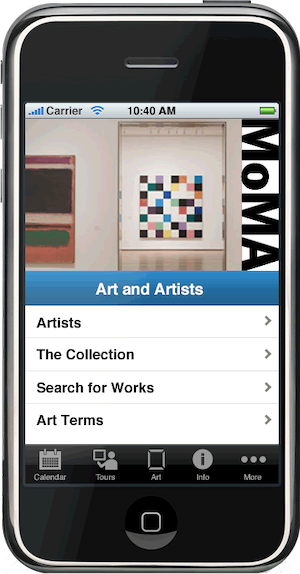
The first version of the MoMA mobile platform.
A scrolling marquee in the gallery, driven by the RSS feed from a BakerTweet device installed in MoMA’s Cafe 2, for the exhibition Talk to Me.
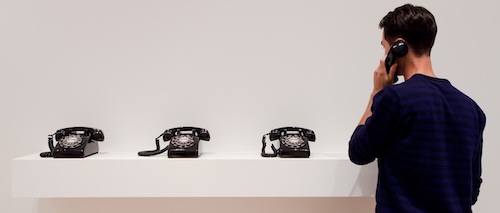
Custom telephony application and web audio player to support artwork “Dial-A-Poem”, by John Giorno, in the exhibition, Ecstatic Alphabets at the Museum of Modern Art.
Windows in the gallery, each with a door over it. Opening a door reveals a high-resolution screen showing works from the collection, and advances to the next. Built on Raspberry Pis for Century of the Child.
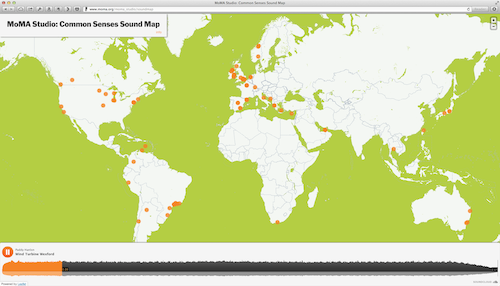
A sound map for exploring field recordings made around the world as part of a multisensory environment called Common Senses in conjunction with the exhibition Century of the Child.
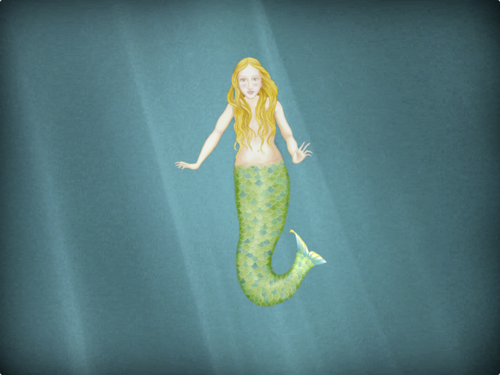
Software for the Mermaid / Manatee installation in the Mythic Creatures exhibit at the American Museum of Natural History.
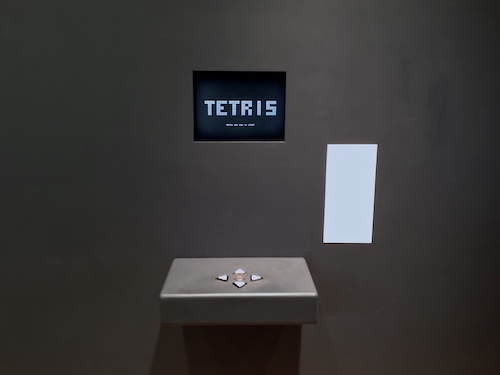
A button interface for the arcade game Tetris, in the Applied Design Exhibition at the Museum of Modern Art.
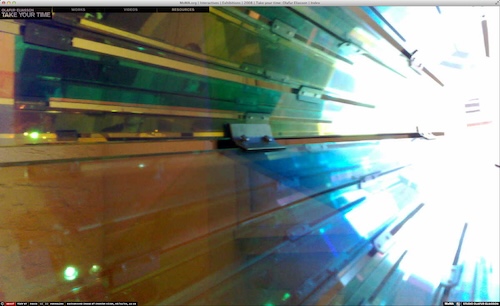
Visitors to Olafur Eliasson’s Take Your Time exhibition at MoMA and PS1 wear cell phone necklaces that record their experience. Selected images are displayed as background on MoMA’s Take Your Time exhibition subsite.
A sound map of silence, made for the MoMA exhibition There Will Never Be Silence: Scoring John Cage’s 4’33”. Participants recorded the “silence” around them, said where they were standing, and selected recordings were added to the map.
A prototype that returns a different Met artwork each day, chosen from open data about your location, the weather, and the day’s news. Built at The Met x Microsoft x MIT hackathon.
Published in New Interfaces for Musical Expression (NIME05), 2005
Recommended citation: Hindman, David and Spencer Kiser. "Sonictroller." Proceedings of the 2005 International Conference on New Interfaces for Musical Expression (NIME05). Vancouver, BC, Canada. pp. 254–255.
Download Paper
Published in Inside/Out, The Museum of Modern Art, 2013
Recommended citation: Kiser, Spencer. "Exploring sound and space with the MoMA Studio: Common Senses Sound Map." Inside/Out: A MoMA/P.S.1 Blog, The Museum of Modern Art. January 14, 2013.
Published in Digital Underground, The Metropolitan Museum of Art, 2015
Recommended citation: Filardi, Liz and Spencer Kiser. "Mapping User Feedback on the Met App." Digital Underground, The Metropolitan Museum of Art. July 22, 2015.
Published in Increment, 2020
Recommended citation: Choi, Jennie and Spencer Kiser. "Connecting to Art: How The Metropolitan Museum of Art Used a Public API to Share 5,000 Years of Human Creativity with Audiences Beyond its Walls." Increment. Issue 14. August 2020.
Shown at the ETel Fair, an informal evening event introducing garage inventors and their below-the-radar creations to a larger audience. Exhibited alongside Dee Harvey and Jenny Chowdhury of NYU’s Interactive Telecommunications Program.
Presented with Michael Jefferson (NYU ITP). Tuesday 7 March 2006, 2:35–3:20pm, Elizabeth Ballroom B.
Poster demo of spinCycle, a synesthetic turntable that lets you arrange and play colours visually and musically. A camera takes the place of the tonearm: rather than a needle playing grooves in a record, spinCycle generates sound from the colours it sees as the DJ arranges brightly coloured plexiglass discs on the spinning platter, rearranging them on the fly to build a new soundtrack.
Presented with Shannon Darrough. In July 2013 MoMA launched a rebuilt version of the MoMA App, created to replace the handheld audio wands distributed in the museum. The talk covered the app’s features and design, an overview of the new system’s architecture, the design collaboration with MoMA’s Education department, and the agile process the development team ran with partners at Pivotal Labs.
Presented with Laura Beiles. In the summer of 2012 we built an online sound map and asked the public to contribute field recordings from their lives, as the sound component of the MoMA Studio: Common Senses space held in conjunction with the Century of the Child exhibition. The map grew to over a hundred recordings - wind turbines in Andalucía and Ireland, chanting from Japan, a manifestation in Madrid, streets in London, a soundwalk through the Museum itself.
Way-finding is a common challenge for museums, often thought to require significant time and resources to solve. The Met’s complex floor plan made developing a useful mobile map for the Met App particularly challenging, especially given our small team and tight timeline. Rather than building an elaborate solution based on assumptions, we quickly developed an MVP that worked on both native platforms. Using a build-measure-learn feedback loop, we iteratively improved the Map based on visitor feedback, enhancing the overall visitor experience.
Served as a peer reviewer on a panel critiquing recent museum apps - iOS and Android, touch tables, kiosks and bespoke hardware, as distinct from websites. Chaired by Stephanie Pau, alongside Ty Pierce, Laura Mann, and Shannon Darrough.
Addresses the history of the Met’s collection in digital form and what makes it unique. Explores the quirks in the data, the categorization challenges, and proposes use cases for machine learning.
An update on Open Access and machine learning at the Met.
Workshop, Museum of Modern Art, 2008
By focusing on the soundscape in which we are immersed, we can find new appreciation of our surroundings, as well as discover a pallette of material from which to create art. The soundwalk is an excellent method for exploring a space and collecting material for sound-based works. Students will learn audio fundamentals and recording and editing techniques, and will participate in listening and field recording exercises. We will also create a digital sound map using the recordings from our field trips.
Masters course, Interactive Telecommunications Program, Tisch School of the Arts, New York University, 2008
An introductory course designed to provide students with hands-on experience using various technologies (online communities, digital imaging, audio, video, animation, authoring environments and the World Wide Web.) The forms and uses of new communications technologies are explored in a laboratory context of experimentation and discussion. The technologies are examined as tools that can be employed in a variety of situations and experiences. Principles of interpersonal communications, media theory, and human factors are introduced. Weekly assignments, team and independent projects, and project reports are required.